Showing posts with label Growth Theory. Show all posts

10. Buckminster Fuller's Elegant Law


Buckminster Fuller's Elegant Law
Bob Komives
::

Growth studies are integral to physiology. Construction is integral to architecture. Economic development should be integral to economics. Yet, economic developers and economists share little common ground. At least one economist, Paul Romer, works to change that by convincing other economists that knowledge and technology are part of economic growth. This seems obvious to a person on the street but revolutionary to most macroeconomists.

Depending on where I run into it, economic development still seems to be more in the kit bag of real estate developers, promoters, and financiers, as well as thought provoking generalists. Confusion among economists makes me no more comfortable with the developers and promoters who play on a simpler stage:

" I create jobs.
You want jobs.
Jobs make community rich.
Give me break.
I will make money.
Then, I will make you
a nice, rich community."

||

Pending some coherent understanding of economic development such a monologue plays well to many audiences.

I find more comfort with the generalist synthesizers who try to comprehend the complex world and take us along for the trial. They look beyond their narrow window on the universe to an ever-expansive view. This is not frivolous pursuit leading to nowhere. Some, such as da Vinci and Einstein left obvious legacies. Others do no less than help us think, create, and pursue our own synthesis. They are skilled people who are generalists and designers.

Generalists:
see pattern
where others see spots,
see hypothesis
where others struggle to see the experiment.
Designers:
see opportunities
where others see problems.

||

One generalist designer got me onto this economic tangent. R. Buckminster Fuller formulated the fundamental law of macroeconomics. Wealth is a function of the knowledge and the energy in the universe.

wealth = function of (knowledge & energy)

The amount of energy in the universe is constant. The amount of that energy that we can call wealth, however, is not constant. It varies as the biosphere grows and changes. According to Fuller's Law, then, knowledge is the only component of wealth that can cause wealth to grow or shrink. This makes sense if we adopt a broad concept of knowledge.

We know something about
food, clothing, shelter,
art, and human rights.
They know some things about us.
Each and all is wealth.
Food is energy
made palatable.
Clothing and shelter are energy
reformed into protection and image.
Art controls and molds energy
to please our senses.
Human rights let us control our own energy
(including our own bodies).
Lacking such energy,
and the knowledge to use it,
we are poor.

||

Buckminster Fuller's formulation for wealth lead him to make a simple prescription for economic development: Increase knowledge! Since the quantity of energy in the universe is fixed, we create wealth only by increasing knowledge. More important, when we increase our knowledge we cannot fail to increase our wealth.

My own formulation is incidentally different, but it leads to the same conclusions:

wealth = knowledge

On this alone I would like to rest my case. What else I have to say is not so clean and simple. I too need more designer synthesis. However, I believe I can argue well that economic development is inseparable from economics. I can lay down some of the bases for a conscious economic development strategy that equates with a sane use of the biosphere and discards the popular conception of a balanced national budget. The knowledge we need is within us, around us, and ahead of us.


:: Bob Komives, Fort Collins © 2006 :: Plum Local IV :: 10. Buckminster Fuller's Elegant Law ::
With attribution these words may be freely shared, but permission
is required if quoted in an item for sale or rent

::::::::::::::::::::::::::::::::::::::::::::::::::::::::::::::::::::::::::::::::

11. Classes of Knowledge, Uses of Wealth


Classes of Knowledge, Uses of Wealth
Bob Komives
::

Knowledge is just an abstract concept
until we tie it to the energy that it harnesses.

The wealth potential of the biosphere
is to have useful knowledge
of all the energy in the universe.

We have reached but the tiniest fraction of that potential,
but take note:

for billions of years the total was zero.

Knowledge makes wealth. Wealth is energy --that energy that is of value because we know how to use it to our benefit. Even when ignorant in our brains of value, something in our body, our society, or our environment knows how to harness the energy of wealth to our benefit. One can benefit from electricity knowing little of its physics and mechanics. Nor is it necessary to know how our immune systems work to benefit from their protection.

As our knowledge increases, our species' wealth increases. As long as our knowledge increases faster than our population, wealth per person increases. Buckminster Fuller saw that if we understand the principles of knowledge formation we understand the principles of economic development. With such understanding we might avoid extinction and continue to partake in evolution's gift of growing prosperity.

Fuller saw energy as physical, yet saw knowledge as metaphysical. Since knowledge is the only variable in his conception of wealth, if it is metaphysical it does not lend itself to measurement. (At least I do not know any metaphysical measurements to apply.) Convinced that Fuller's Law held much more promise than the collection of theories that were passing for macroeconomics, I looked for a way to reformulate the law so that we might test it alongside other physical laws that we reveal through science. There should be notation that can express Fuller's Law in physical terms. Knowledge could then be discussed as a quantity even if measurement were still impractical.

After an enjoyable, but long, struggle with this measurement problem I saw that it simplifies if we think of one instant in time and ignore any complications from the relativity of time across the vastness of the universe. At one instant as seen from one point in the universe, knowledge is not metaphysical. It acts upon discrete units of energy. At that instant all of the energy of the universe can be divided into three classes.

Class-w energy is the knowledge (wealth) of a particular species, ecosystem, community, or other subordinate part of the biosphere. Human wealth is class-whuman.

Class-W energy is biospheric knowledge. It includes all class-w energy.

Class-U energy is all the energy in the universe, including class-W.

Since knowledge and energy are inseparable at this instant, we can measure knowledge by measuring the energy to which it has attached. Our human wealth equation becomes a summation of this attached energy:


∑wealth = ∑knowledge = ∑class-whuman energy

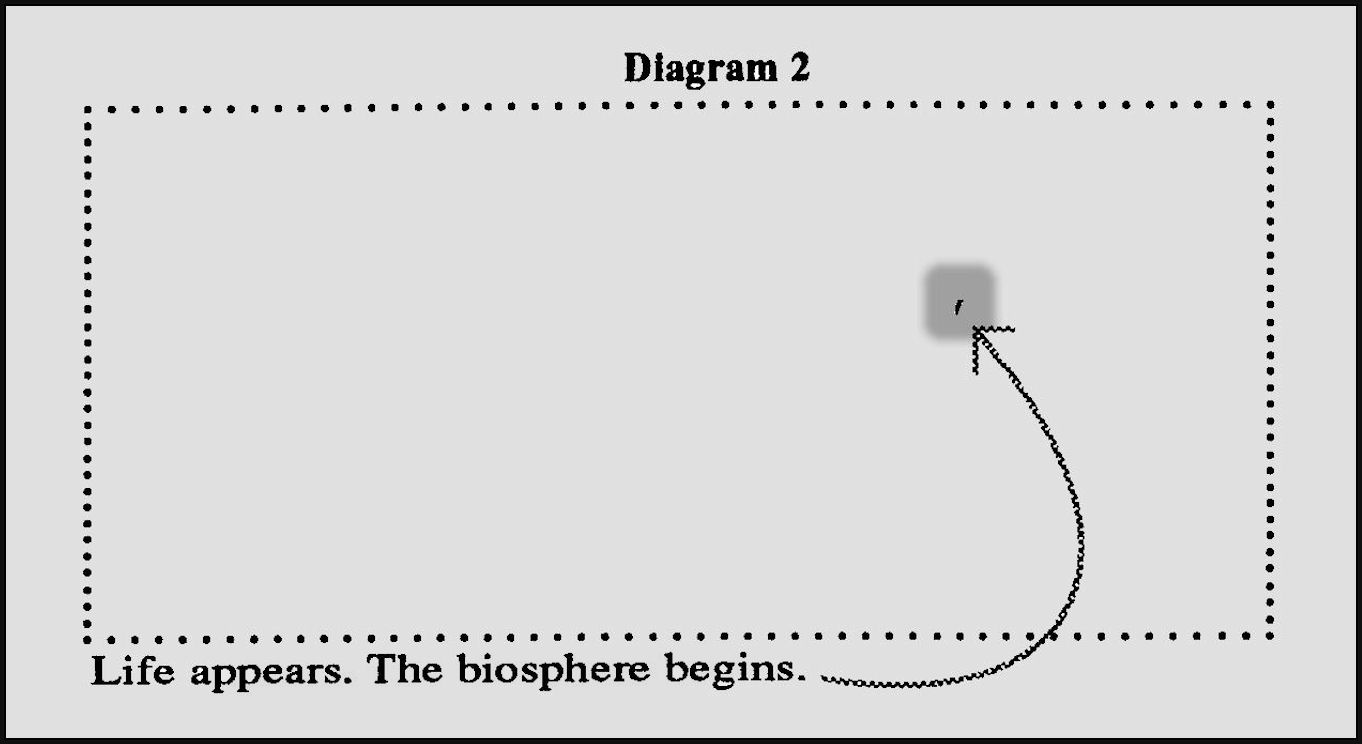
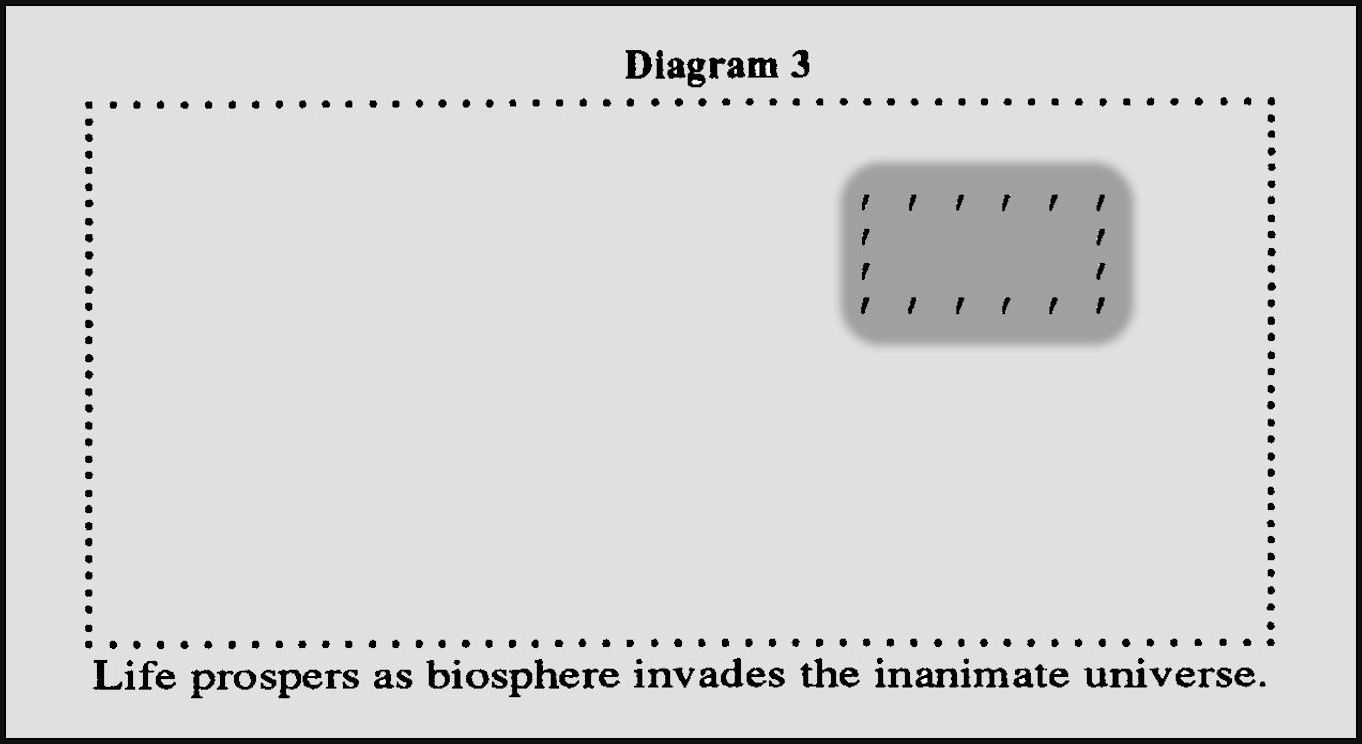
When life appeared the amount of the energy in the universe devoted to life went from zero to a tiny amount. As life multiplies that amount stays tiny relative to the universe but steadily increases. Life's invasion of the inanimate universe has begun. Earth has become a biosphere. Life captures inanimate energy and organizes it into its systems. Some newly captured universal energy gets bound into living creatures. A larger amount --still inanimate-- serves as storehouse of energy for life support. Life exploits this storehouse as food and as supportive environment in which to survive and prosper. This captured, organized energy is life's wealth. It includes the growing amount of energy that actually knows how to live and the expanding reservoir of inanimate energy that life knows how to exploit. So it is for our species. Our class-whuman energy is the energy that knows how to be we, plus other biospheric energy that we know how to use to our benefit.

That part of Class-W biospheric energy that we cannot count in our class-whuman wealth is quite important. It measures our ignorance.


:: Bob Komives, Fort Collins © 2006 :: Plum Local IV :: 11. Classes of Knowledge, Uses of Wealth ::
With attribution these words may be freely shared, but permission
is required if quoted in an item for sale or rent

::::::::::::::::::::::::::::::::::::::::::::::::::::::::::::::::::::::::::::::::

12. Our Challenge: Grow Into The Biosphere


Our Challenge: Grow Into The Biosphere
Bob Komives
::


When we admit that parts of the biosphere
lie beyond our wealth estate
we receive no license to destroy,
but, rather, a challenge
--rather our challenge to integrate.

||
Exploration can lead down unexpected and unsought paths. I found it helpful to divide wealth into classes. However when I distinguished class-W (biospheric wealth) from class-whuman (human wealth), I worried that I was about to conclude that we could do without much of the biosphere --that we can afford to destroy any of the biosphere that is not classified as human wealth. I sketched a series of diagrams that helped me to another conclusion.


When we have the power to eliminate a form of life from the biosphere, a form that we do not know as wealth, we must face a truth; we have the power to eliminate a source of future wealth.


Humankind has no sympathy for smallpox, but smallpox is some of what the biosphere knows. We must ask, "What does smallpox know that we do not know?" From the point of view of the smallpox virus, its sphere of wealth (class-wsmallpox) shrank from a large portion of the biosphere, where it devastated human populations, to its imprisonment in a few isolation units. Our concern has shifted. Once we feared for our survival. Now we must fear loss of biospheric knowledge into which we might one day grow.


Humankind is of the biosphere.

Biosphere is of the universe.


Life's challenge to the biosphere:

. become one with your universe.
Life's challenge to humankind:

. become one with your biosphere.
Meeting --or failing-- our challenge

we will change:

. change in form
. change in method
. change in abundance.

||

:: Bob Komives, Fort Collins © 2006 :: Plum Local IV :: 12. Our Challenge: Grow Into The Biosphere ::
With attribution these words may be freely shared, but permission
is required if quoted in an item for sale or rent

::::::::::::::::::::::::::::::::::::::::::::::::::::::::::::::::::::::::::::::::


15. Capture, Distribute, And Recirculate Wealth


Capture, Distribute, and Recirculate Wealth
Bob Komives
::


I divide wealth development into three processes that interconnect in an evolving spiral. The three processes are: capture, distribution, and recirculation. The following diagrams help me see how wealth of biosphere and its parts can grow. Among the casualties of simplicity, I ignore backward steps such as death and disorganization.

I will describe these diagrams as starting at the origin of the biosphere, but, with simple changes in vocabulary, they could start today and look at one person, a tidal pond, a human community, an ant hill, a business, or a watershed. As the diagrams progress, more energy of the universe serves life, and life becomes more complex.


The number of creatures increased tenfold between diagrams 8 and 12. The amount of energy in the biosphere increased more than tenfold because energy captured from the universe gets distributed and recirculated before leaving the biosphere at a rate somewhat slower than it enters.


:: Bob Komives, Fort Collins © 2006 :: Plum Local IV :: 14. Capture, Distribute And Recirculate Wealth ::
With attribution these words may be freely shared, but permission
is required if quoted in an item for sale or rent

::::::::::::::::::::::::::::::::::::::::::::::::::::::::::::::::::::::::::::::::

16. Biology, Brain, Artifact: Our Wealth Stores


Biology, Brain, Artifact: Our Wealth Stores

Bob Komives
::


Where do we store our wealth of knowledge?
Evolution gave us a nervous system,
a brain, wherein we learn our environment
and attempt to respond to change.
Our brain holds memory
wherein we store our learning for later use.
We learned to create artifacts,
utilitarian and coded,
that, once made,
hold our knowledge.
Nests and tools,
paintings and hearths,
books and buildings
may survive our death
to be inherited by following generations
that may use and build upon this heritage.
Our life-time learning,
our artifacts,
and our biological heritage
combine to organize our culture.
||
We can classify human knowledge by where we store it. Carl Sagan wrote of genetic and extragenetic locations.

Genetic knowledge is written in the nucleotides in the chromosomal DNA molecules. As life evolved its forms became ever more complex. Genetic code had to contain more information. Humankind has more genetic information than most other mammals, which have more than amphibians, which have more than protozoa. Depending on mutations and natural selection, this genetic form of knowledge grows slowly and is limited by its container, the chromosome.

Extragenetic knowledge resides outside of our chromosomes. Much is written during our lifetime in the memory of our brain. Because we can learn and be taught, our species can adapt quickly to problems and opportunities presented by our environment. But brain knowledge dies with each individual unless she has somehow passed it on to someone else. It is still sharply limited by the capacity of a brain to learn and apply information during one lifetime.

Some extragenetic knowledge, however, is also extrasomatic; it is stored in artifacts outside our bodies. Utilitarian objects and coded messages augment our ability to capture and use energy. Humankind does not have exclusive access to such knowledge, but we are the experts. Libraries are obvious examples, but tools, houses, and other useful objects contain knowledge. These inanimate objects may have a usefulness that is independent of the life span of the people who create them. The objects tend to accumulate, offering each successive generation an opportunity to be more knowledgeable (wealthier) than the previous one. Nor is it necessary for the user to know as much as the creator.


To use our hammer of steel and wood
we must know to grow and manage arm and hand.
We must learn how and why to wield our hammer.
Yet, we need not know how
to make or shape steel,
to select wood
nor make a handle.
Someone put this into our hammer,
so we can use without knowing.
Someone Put This Into Our Hammer

I classify knowledge by location as: biological knowledge, brain knowledge, and artifactual knowledge.

Biological Knowledge. It includes the genetic codes, most of the living tissue of each living creature, and any energy immediately at the disposal of this knowledge. For an earthworm it includes himself, the soil that surrounds him, that is about to be consumed, and that that is being consumed. For the biosphere, it includes the biomass plus most of the inanimate materials and gases just above and below the Earth's surface, and beneficial energy arriving at Earth from the sun and elsewhere.

Brain Knowledge. It includes information and skills learned by individuals from their environment during their lifetime as well as any energy immediately at the disposal of this knowledge. For the human who has learned to swim and dive for clams, it includes the water supporting her and the clam she is about to grasp. For the biosphere, it includes any increase in biomass or captured energy that is due to brain knowledge -for example, the fish stocked and propagating in a natural lake that had no fish until knowledgeable humans intervened.

Artifactual Knowledge. It includes knowledge outside our bodies, and any energy immediately at the disposal of this knowledge. For a cold human it includes his stove that incorporates brain knowledge of metallurgy and the science of burning. It includes the firewood in and immediately nearby his stove, as well as the food he is about to cook, and his cookbook. For the biosphere, it includes a man-made fish pond, the solar panels on a space vehicle, and the energy that each captures.

Knowledge organizes and reorganizes the world. Biological knowledge sustains basic processes and carries the fundamental codes of life. Brain knowledge augments the amount of energy that an individual, a group, an ecosystem, a species, or biosphere can put to beneficial use. Artifactual knowledge can harness and release vast quantities of energy that the body and mind cannot manage directly.

Brain knowledge increases rapidly for each new individual. An ignorant baby becomes a knowledgeable adult. We organize ourselves so that we can pass much wealth from individual to individual and from generation to generation through example, oral tradition, ceremony, song, dance, and vocabulary. Much brain knowledge also comes from direct personal experience. This wealth accumulates much faster than does genetic change, but it is inefficient. It usually passes to only a small group before the teacher dies. It may be forgotten or misunderstood. Much brain wealth dies with each individual.

Artifactual knowledge increased slowly in the early millennia of mankind. One generation left simple hand tools in wood, stone or bronze for the next generation. Supplemented by a transfer of brain knowledge through teaching and demonstration, these artifacts often retained their usefulness over generations. Each new generation could not only make new tools but use those accumulated by earlier generations. When nomadic groups converted to stationary communities they could keep more of the tools made by past generations. We still use simple hand tools. They often help us build complex machinery and electronic equipment that in turn we can use to manufacture better, less-costly simple hand tools. Our artifactual culture builds upon itself.

Written language is itself an artifact (in code) that helps us store instructions for using and building other artifacts. Instructions might otherwise be forgotten or severely limited in distribution. Using this coded artifact, our brain knowledge can quickly and temporarily grow to suit the need at hand. We only need to know how to read the language.

I illustrate the interworking of the forms of knowledge with a simplified view of the ancient Egyptians and their culture that flourished along the Nile River. They relied without thinking about it upon their biological knowledge to keep their bodies functioning long enough to reproduce themselves and to accumulate and transfer brain knowledge. With their brain knowledge they could understand the seasons, the floods, the principles of agriculture and mechanics. Combining biological and brain knowledge, specialized engineers could build dikes and irrigation systems. These artifacts enabled many who knew nothing of engineering to increase their food and fiber production. In the process, Egyptians developed new strains of plants by selecting seeds from those plants that took best advantage of this man-altered growing system. These plants, though having their own genetic wealth, were living artifacts storing extrasomatic knowledge for the ancient Egyptians and we who follow. A complex system of biological, brain, and artifactual knowledge built an increasingly productive culture that gathered ever more energy unto itself.

In a purist sense, the three forms of knowledge are downwardly dependent. Biological knowledge came first; it can exist without the more advanced forms of knowledge. Brain knowledge evolved with increasingly sophisticated nervous systems. It obviously depends upon the genetic code of the body that hosts it. Artifactual knowledge exists outside the body. However, without brain knowledge and biological knowledge there would be no one to take advantage of it. It would cease to be wealth.

This hierarchy of dependence is valid, but difficult to apply. Much biological wealth depends on brain knowledge or artifactual knowledge. Pigeons can exist without humankind, but their population would be much lower without the artifacts of man, city buildings. Holstein cattle owe their unique characteristics to careful breeding by humans. They are living artifacts for humankind, but biological wealth for themselves. Astronomy is mostly brain knowledge, but much of it depends upon artifacts such as telescopes. In our complex patterned biosphere the forms of knowledge interact and interdepend.


:: Bob Komives, Fort Collins © 2006 :: Plum Local IV :: 61. Biology, Brain, Artifact: Our Wealth Stores ::
With attribution these words may be freely shared, but permission
is required if quoted in an item for sale or rent

::::::::::::::::::::::::::::::::::::::::::::::::::::::::::::::::::::::::::::::::

29. From Amoeba to Market


From Amoeba to Market

Bob Komives
::


We can, I suppose,
think of a chemical reaction
at the nucleus of a tiny amoeba
as but one reaction
in
.... a
........chain
..................that
..........................extends
from this amoebic nucleus
to the farthest reach of the biosphere.
We should rather, I propose,
notice this amoeba has a surface,
its working edge,
where universe divides in two;
where biosphere divides into
what-is-this-amoeba
---and-----------
what-this-amoeba-is-not.
Where Universe Divides In Two

Early creatures had centers and edges. Evolution gave them ways to move energy around the center, from edge to center and from center to edge. Communal biological wealth in the amoeba keeps its primitive power and control systems functioning. At its edges, the amoeba uses genetically coded knowledge to capture food. However, one amoeba has no control over the likelihood that food will be there to capture.

There is friction. One amoeba may find itself in competition for food with other amoeba, other creatures. Lacking the sophistication to sign treaties or to create a marketplace the amoeba relies on programmed gathering techniques to bring fuel into itself. At its edge the amoeba competes and cooperates with its surroundings to overcome friction, to transfer wealth from the larger biosphere into its one-cell body.

As life forms become more complex, so do the options for wealth transfer at edges, and for wealth distribution and recirculation at centers. Humankind has experimented with a variety of methods to organize its centers. At some scale we call these experiments family. At other scales we call them government. We have a propensity to form governments and never seem satisfied with our results.

As family met family, group met group, and nation met nation, we experimented with government-type solutions at our edges also. As alternative to war, raids, walls, and moats, the marketplace was such an experiment. Participants agreed upon marketplace rules in order to minimize risk to themselves and their goods. These rules and their enforcement were the government of the moment, the communal base for marketplace.

Fringe trading deals with new goods and services more readily than does communal tradition. We need only a willing buyer, a willing seller, a place to bargain, and security for the individuals, their goods and services. Traditional distribution may create successful investment, but that same tradition may be inadequate to guide the distribution of new types and quantities of wealth produced by the investment. With or without the sanction of traditional leaders, individuals might resort to edge-type trading to distribute these new goods and services.

Some governments came to approve of this internal trading, but also took control -setting and enforcing the rules. Thus, government became communal sponsor of free enterprise. Internal edge-economies became important. Marketplace society was born.


:: Bob Komives, Fort Collins © 2006 :: Plum Local IV :: 29. From Amoeba to Market ::
With attribution these words may be freely shared, but permission
is required if quoted in an item for sale or rent

::::::::::::::::::::::::::::::::::::::::::::::::::::::::::::::::::::::::::::::::

36. Work For Economic Development.


Plum Local IV ::: Part II
Community Investment

=== chapters 36 - 43 ===
=== look to right column for direct links to chapters ===


36. Work For Economic Development

Bob Komives
::

Why get a new brick
if I can dig up an old one?
This brick has lane three places in twenty years.
I dug it up twice,
laid it down twice--
each time thinking the brick work was done--
each time pleased with my work.
Even today, it did not displease me,
but it will please me more over here.
Why Get A New Brick?

Economic development is the work of life. My father liked to quote his Hungarian father: "Nincsen munka, nincsen sonka;" "No work; no ham." Perhaps a less literal but better translation is: "No work, no live." Both my grandfather, who repaired street cars, and my father, who repaired railroad cars, were speaking of physical, often-unpleasant work, the purposeful expenditure of energy. They were speaking of labor, the human effort that economists say turns capital into productive wealth. Yet, "work" has another meaning that I am sure was familiar even to my grandfather who spoke English as a second language and only outside his home. If brakes he had repaired were to show signs of failure on the street car taking his family down a steep hill to a Sunday picnic, "work" would have had the other obvious meaning: "If these brakes don't work, we die."

Work is function, effect, and, in physics, the application of force over a distance. Work is not brute labor. It does things. Most good students work hard to learn, but excellent teachers and parents know that much is taught through play. Play is every bit as good as work --if it works. I look around at nature and see much of it at play, yet I do not hesitate to describe an interesting flower or phenomenon as "nature at work." Science, art, and the Sunday picnic are human nature at work. I like to think that they have done as much for our economic development as have Monday in the office, Tuesday in the factory, or Wednesday on the farm. If you think not, I hope you will at least agree that they do work for our economic development.


:: Bob Komives, Fort Collins © 2006 :: Plum Local IV :: 36. Work For Economic Development. ::
With attribution these words may be freely shared, but permission
is required if quoted in an item for sale or rent

::::::::::::::::::::::::::::::::::::::::::::::::::::::::::::::::::::::::::::::::

37. Organize For Economic Development.


Organize For Economic Development
Bob Komives
::

Economist, please try to define
why our wealth (1) can grow and (2) decline.

Please Try To Define

Life had to learn how to work for itself. It had to learn to sustain and expand itself in its home, the biosphere. It now knows how to organize itself to capture and expend energy with purpose, and to produce results that function. As life expands, it learns more ways to organize. Life's library of workable knowledge sustains it during tranquillity and changes it during crisis. The library grows larger and more diverse, even as it loses some works --species and ecosystems that have disappeared.

Knowledge is the wealth of the biosphere, the product of good work and good fortune. It organizes biospheric development, human development, human culture. Biological knowledge encoded in genetic libraries sustains the complex processes that mold inanimate energy into animate energy and animate energy into complex patterns. Brain knowledge adds real-time, real-life learning to the library. Artifacts, artifactual knowledge, organize and maintain energy in ways that genes and minds cannot.

In ancient Egypt, farmers who knew little of engineering drew upon the greater engineering knowledge stored in irrigation structures, systems, and administration to increase food and fiber production from their work. As they learned which plants did best, they stored their improving knowledge in each generation of seeds --selecting seed from superior plants. The improved varieties were their living artifacts, storing knowledge for children who used that knowledge without relearning it. They simply planted seeds of the improved varieties. Brain knowledge also passed from one generation to the next through written and spoken words and diagrams. And, of course, this knowledgeable culture could not have survived if men and women had not known to reproduce themselves and nurture their offspring into adulthood. Complex biological, brain, and artifactual knowledge were both essence and cause of a productive culture --not perfect knowledge, not perfect culture, but alive and long-lived.

Economics should explain how our species organizes itself for work that produces and sustains well-being. It should explain why "prosperity" is not "well-being" unless it works to promote likelihood of survival in our species and our biosphere. In short, the economist should describe the rules of organization for economic development.

Wealth is our preoccupation--
it is not our invention.

Economic development is an organized invasion--
life invades the universe.

Do not try to create economic development.
Be, instead, a knowledgeable partner.
Practice stewardship and equity.
Learn more.
Share knowledge.
Know to organize to foster the biosphere.

Know that wealth can disappear--
species, ecosystems, and cultures become extinct.
Guard against
the natural disaster,
nuclear war,
and revolution
that can destroy knowledge--
leaving machines that no one can use,
books no one can read,
science no one can remember.

Guard against the disappearance of life,
for the biosphere knows how to become wealthier.

Prevent the destruction of our species,
for we can learn to partake of that increasing wealth.

Stop exploiting one another,
for then we can partake of more wealth more quickly.

Bring our understanding of the world into harmony
with the knowledge embedded in the universe.

Thus,
we shall act as consistent development partners--
in our human sphere
in our biosphere.

A More Knowledgeable Partner


:: Bob Komives, Fort Collins © 2006 :: Plum Local IV :: 37. Organize For Economic Development. ::
With attribution these words may be freely shared, but permission
is required if quoted in an item for sale or rent

::::::::::::::::::::::::::::::::::::::::::::::::::::::::::::::::::::::::::::::::

43. Community B And The Back Rub


Community B and The Back Rub
Bob Komives
::

Increased breadth in our community economy does not by itself make us feel more wealthy. However, increased depth and density can make us feel wealthier. To see this, imagine two isolated communities that have been stable, both in depth and breadth. Their populations hardly fluctuate; government and traditions are stable. They each have stable economies supported by the harvest of fruits from the forest, a few native crafts, and by entertainment that includes dance and dream interpretation. The two communities are identical, with one exception. Community B recently discovered the art of back rub. The back rub has become a desired service in Community B. Several skilled back rubbers stay busy.

While Community B harvests no more food or timber than before, some individuals do harvest extra so they can give it to the back rubbers in exchange for a rub. The back rubbers have been freed of their need to harvest. Having those needs satisfied and time to spare, they can be induced to give a back rub if others offer food, a dream interpretation, a dance, a party. Gradually, the interchange of all goods and services in the community has increased. Dream interpreters do more. There are more dances. More people get invited to more parties. To accommodate the newly desired good, the community has increased the density and speed of its distribution and recirculation. It has grown in depth and density.

While extraction has not increased, people have become more efficient in their use of the resources they extract. This is partially due to skill improvements that come with increased specialization. But it is mostly due to a new incentive to do more with less, to ephemeralize. Ephemeralization has occurred in the use of fruits of the forest. One way to get a back rub is for specialists to carve ten wooden bowls and leave less waste from a branch that would yield only eight using traditional methods. These two extra bowls might buy a back rub, or a dream interpretation, or a dance. Thus, while extraction has not increased, the amount of energy bound into the wealth system of the community at any one moment has increased.

Residents of Community B feel wealthier. To the residents of Community A they look wealthier. In real economic terms they are wealthier. Even by conventional measurement, the economic development is obvious. The gross community product shows a marked increase. How? Gross community product is calculated by counting the same energy several times as it appears in different places and forms. This redundant counting correctly reflects increased wealth in the community.

Of course, events did not have to come out this way. The back rub might instead have overburdened social and political systems. The resulting havoc or revolution might have made the community fall backward or apart. Such is the risk of change. Economic development must be imperfect or it will stop. Yet, the Community-B experience, economic development in depth and density, does happen.


:: Bob Komives, Fort Collins © 2006 :: Plum Local IV :: 43. Community B and the Back Rub ::
With attribution these words may be freely shared, but permission
is required if quoted in an item for sale or rent

::::::::::::::::::::::::::::::::::::::::::::::::::::::::::::::::::::::::::::::::

44. A Better Money Legend


A Better Money Legend
Bob Komives
::


Who Created Money?

Money is one of humankind's great inventions.
I was not around when it was invented,
but I do think I know how it happened.

In the third or fourth grade I was taught:
primitive people traded things for things;
we needed a better means of exchange;
we invented money.
What an image!
These hapless primitive people
dragging around elephants and chickens
to exchange for coconuts,
while their suave modern cousins
sit under a tree sipping coconut milk
passing a few coins back and forth.
I have since heard many adults and children
tell this same simple history.
My hair was turning white
when I found something missing--
Who?
Granted,
trading chickens for coconuts could be cumbersome
for the poor folks who walk to the marketplace,
but poor folks do not create money.
Kings, queens, emperors,
bankers, and empresses create money.
They always have plenty of burly helpers
to carry their chickens and coconuts.
Which one said:

"My poor subjects are so overburdened.
Trade is so bulky.
I, nice person that I am,
will give them a means of exchange."

Even if one leader were that smart and that good,
why did cruel and dim despots continue the practice?

Listen to this story.

Let us imagine that first money was made of gold,
and it was issued by an empress.
Before making her coins the empress needed gold. 

Whether she stole it,
got it through in-kind taxes,
inherited it,
or had it mined in her own mines,
she had a storehouse of gold.
Gold held great value in her empire.
She could buy armies, loyalty, roads, music, or whatever.

Now, suppose her artisan made her a radical proposal:

"Your highness,
you are so beautiful;
I am so skilled.
Let me melt your gold
and cast it into little disks
carrying my beautiful rendering
of your beautiful face."

She feels flattered and tempted.
But she says,
"no,"
and puts the artisan in the dungeon for treason.
After all,
some gold would spill on the foundry floor.
The artisan could hide away bits of the gold--
making him a rich and disloyal man.
Many laborers would be needed.
The melting would use up many trees.
The dungeon was almost too little punishment.

Then there arises a great crisis in the empire.
In the east a horde of barbarians prepares to invade.
In the west, three princes want a good road to market.
Without it they may sever their lands from the empire.
The empress summons her advisers.
They report:

An army to defeat barbarians
costs 10,000 pounds of gold.
A good road over the mountains to the west
costs 10,000 pounds of gold.
In the empress's storehouse
are 10,000 pounds of gold.
The barbarian invasion by itself,
or the secession of the princes by itself
will bring destruction of the empire
and death to the empress.

Despair sets upon the empress and her advisers--
until she remembers the artisan.

"Free the artisan
Instruct him to melt all my gold
and mint me 20,000 gold coins carrying my image.
I proclaim,
each coin has a value of one pound of gold.
Spend these coins to raise an army.
Defeat the barbarians.
Build a road over the mountains to the west."

In her selfish interest the empress spends coins.
Her subjects must accept them at twice their value in gold.
Through this great and official hoax
she proposes to save her empire and her life.
To her own amazement,
the hoax works.

She builds the road.
The western provinces boom in productivity
as ever more commerce uses the new road.

She defeats the barbarians.
In the eastern provinces,
under peace and stability,
farmers and artisans produce as never before.

Once coerced to accept the coins,
citizens now covet them.
With more goods and services to buy
people welcome the new means to buy them.

The secret cannot be confined to one empire.
Kings, queens and emperors imitate the great hoax.
Some invest their coins wisely and prosper.
Their subjects revere and follow them.

Other rulers are less wise.
They spend their diluted gold coins
on pleasures that drain wealth rather than nourish it.
Drowning in a sea of over-valued coins,
their subjects resort to trading of a-good-for-a-good,
and they rise up to throw out their worthless rulers.

Who created money?
Someone powerful and selfish and a little wise.
Someone like the empress.

Who Created Money


:: Bob Komives, Fort Collins © 2006 :: Plum Local IV :: 44. A Better Money Legend ::
With attribution these words may be freely shared, but permission
is required if quoted in an item for sale or rent

::::::::::::::::::::::::::::::::::::::::::::::::::::::::::::::::::::::::::::::::

48. Efficacy Limits


Efficacy Limits
Bob Komives
::


There are limits to sensible, productive paper investment. They are efficacy limits. If some investment works but more investment does not work, then more is too much. At some point resources and society cannot respond efficiently to the competing demands. At that point some investments fail. They are good ideas that prove ineffective because they are poorly timed. Efficacy limits are not dollar limits. Money is sibling to unsecured loans and common stock. Like good borrowers and good corporate stock issuers, our national government will produce better budgets when it seeks to make good investments that are well timed. National government need not concern itself with the amount of money that it has on hand nor the amount expected to come in. It should rather consider what effect investment and non-investment will have on the wealth of the country and the international community of which it is a dependent.

The insidious implication of the balanced budget fantasy is that a national government would seem to never have to apologize for its expenditures if they do not exceed the amount of currency returning to its treasury:

"We ruined the country
and much of the rest of the biosphere,
but we never ran an unbalanced budget."

from: A War Rages

:: Bob Komives, Fort Collins
© 2006 :: Plum Local IV :: 48. Efficacy Limits ::
With attribution these words may be freely shared, but permission
is required if quoted in an item for sale or rent

::::::::::::::::::::::::::::::::::::::::::::::::::::::::::::::::::::::::::::::::